Anti-theft backpack with USB port: what 36.90 € actually buys
Anti-theft backpack with USB port at 36.90 €: 47 × 31 × 16 cm, 1.15 kg, hidden zips, power bank not included. An honest review, with strengths and limits.
Key takeaways
- Price checked on 6 November 2026: 36.90 €, shipping included.
- 47 × 31 × 16 cm and 1.15 kg empty, according to the product visual.
- The USB port is a pass-through: you supply the power bank.
- No lock, no RFID, no USB-C at this price.
- At 47 cm tall, it fits under most airlines' cabin gauge, but check yours.
- City trips and weekends: yes. Hiking: no.
Anti-theft backpack with USB port: what 36.90 € actually buys
There’s a precise moment when this bag earns its place. You’re standing on a crowded commuter train, the bag on your back, and the main zip sits within reach of anyone behind you. You can’t see it. That’s the move a pickpocket is looking for, and that’s exactly what the anti-theft design moves away.
At 36.90 €, shipping included, the bag doesn’t make your gear untouchable. It makes access slower and more visible: the main opening sits against your back, the zips disappear under a fold of fabric, and a flat pocket rests against your lumbar area. Everything else deserves a closer look: the USB port, the 16 cm depth, the power bank that isn’t in the box.
This guide uses the figures printed on the product visual and the spec sheet. No paid test.
The real problem: the pocket on your back
A backpack exposes two zones. The front panel, with its outer pockets that are easy to open. And the main zip, which runs across the top and sometimes down the sides. In a crowd, nobody notices a hand pulling a 10 cm zip: bodies cover the movement, announcements cover the sound.
Three situations come up again and again:
- Rush-hour metro: the doors close, the bag is squeezed against strangers.
- A café terrace: the bag sits on the floor, back to the room, zip within reach.
- The boarding lounge: travellers doze off, the bag beside them, often open.
The anti-theft design doesn’t remove the risk. It moves the opening against your back: to get in, you have to take the bag off or spin it round. A determined thief can still cut a strap or walk off with the whole bag. No 36.90 € backpack solves that.
How the anti-theft system works
The main zip sits flat against your back, under a flap. To reach it, you have to take the bag off, set it down or turn it. In motion, the move becomes visible. It’s a simple mechanical defence, with no electronics and no app.
Hidden zips: what actually changes
The pulls slide under a fold of fabric. A hand searching blind doesn’t find them in one second, and that second matters in a crowd. At 36.90 €, the system stays mechanical: no combination lock, no TSA ring, no cable strap.
No lock, no RFID: what to know
The spec sheet mentions neither a lock nor RFID protection. If you want a shielded pocket for your cards, this model doesn’t have one. The shop sells an RFID passport wallet at 16.90 € that does that job separately. The bag protects physical access, the wallet protects card data.
The back panel also has a flat zipped pocket against the lumbar area: phone, passport copy or bills, invisible while the bag is worn.
The USB port: how it works
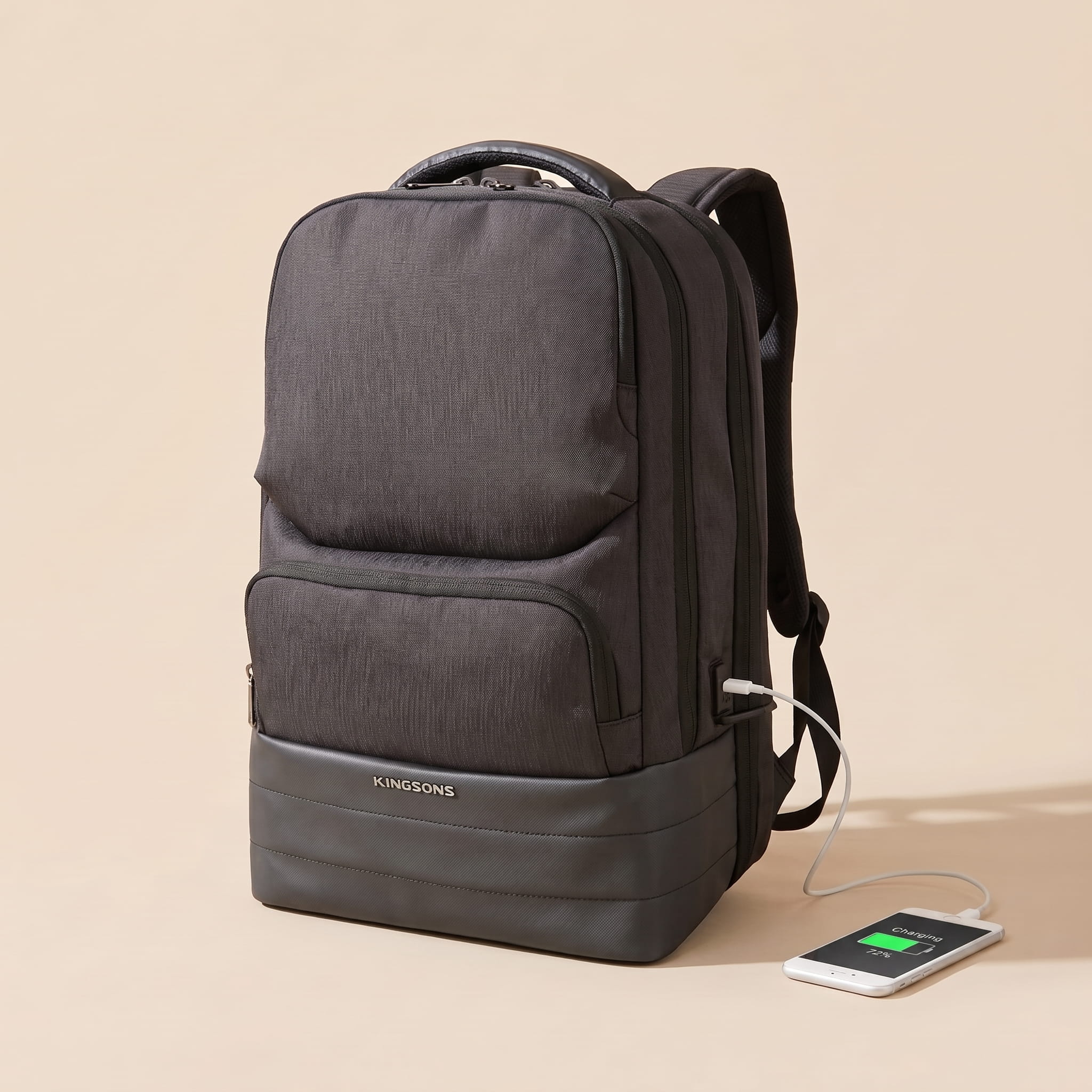
The outer port isn’t a charger. It’s a pass-through: a short USB cable inside the bag links a power bank stored inside to a socket on the side. Your phone plugs in outside, the battery stays inside.
Connecting a power bank
- Put the power bank in the inner pocket, near the cable channel.
- Plug the internal cable into the power bank.
- Connect your phone cable to the outer port, then to the phone.
The battery isn’t included. That’s on the spec sheet, and it makes sense: the maker doesn’t know your phone or your habits. The real budget goes past 36.90 €.
What the port doesn’t do
No USB-C, no Power Delivery, no fast charging announced. The sheet mentions a USB interface, with no wattage. If your phone needs 30 W to recover 50 % in half an hour, the port changes nothing: the speed depends on your battery and cable.
Dimensions, weight and volume: the verified figures
The product visual gives 47 cm high, 31 cm wide and 16 cm deep, for 1.15 kg empty. Multiply the three and you get 23.3 litres of theoretical volume. That’s a geometric maximum: a soft bag deforms.
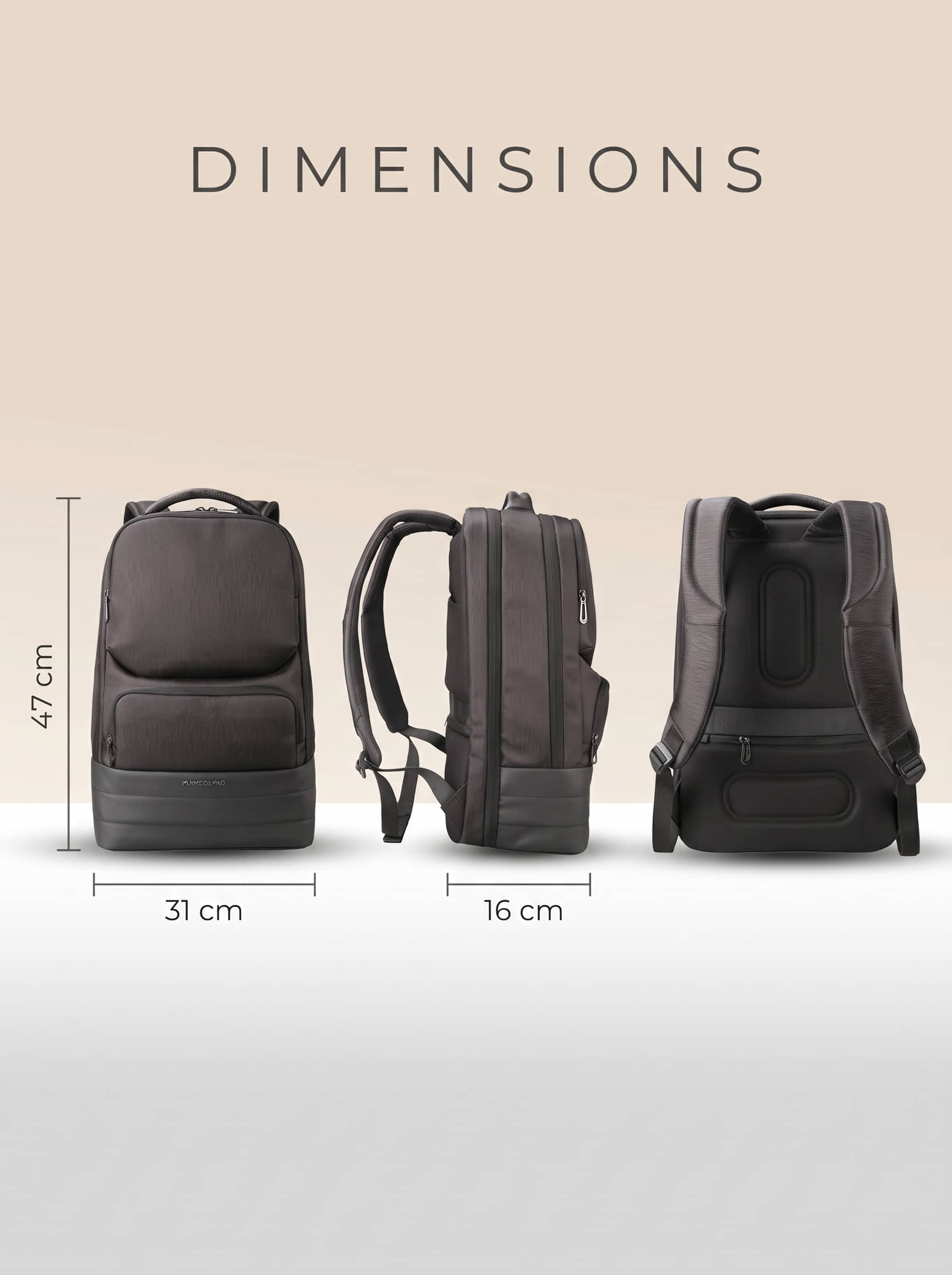 Those 47 cm match the height of a 15-inch laptop bag. The 16 cm depth is what separates it from a flat commuter pack: a jumper or a compact camera goes in without forcing the zip.
Water-repellent, not waterproof: what rain really does
The high-density polyester has a water-repellent finish, and the lining is nylon. Water runs off instead of soaking in. In light rain, your gear stays dry for a short walk. In sustained rain, water gets through the seams and zips: they don’t seal.
At 36.90 €, no bag is fully waterproof: taped seams and sealed zips cost more to make. For an hour in the rain, add a rain cover. The bag handles the station-to-hotel walk, not a hike in a storm.
Laptops: which sizes fit the compartment
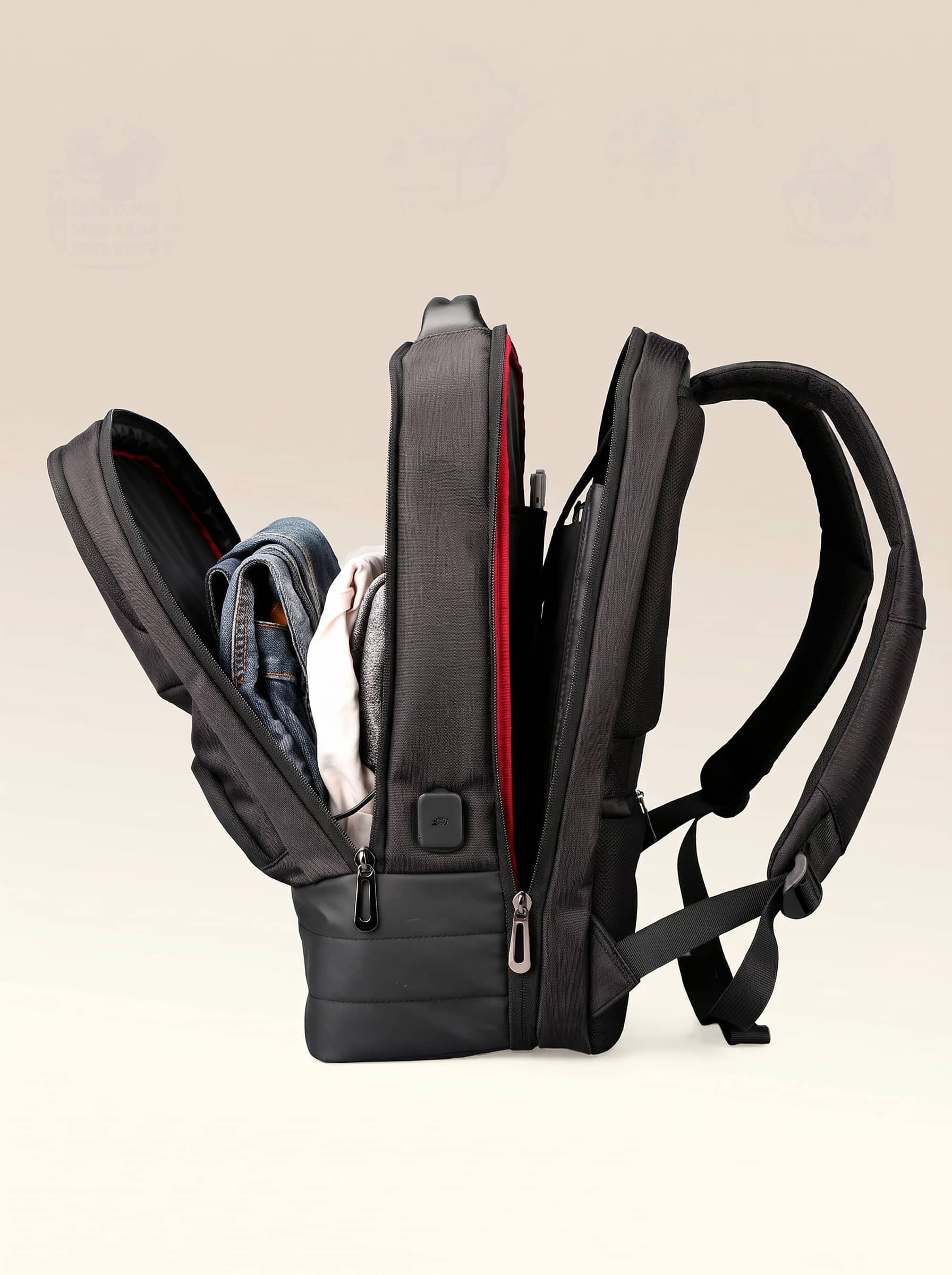 The compartment is padded and suspended: the sleeve doesn’t touch the bottom, which limits shocks when you set the bag down. The maker doesn’t publish a maximum screen size, but the bag’s measurements give a good idea: 47 cm high, 31 cm wide.
A 15.6-inch laptop measures about 36 cm by 25 cm: it fits with room to spare. A 17-inch model, around 41 cm by 28 cm, still goes in, but the sleeve gets tight. Three checks:
- Measure your machine with the lid closed.
- Compare with the usable height, 47 cm minus the padding.
- Make sure the zip closes without forcing.
Cabin or hold: what airlines actually allow
At 47 × 31 × 16 cm, the bag stays under most airlines’ cabin gauge, which often sits around 55 × 40 × 20 cm. Low-cost carriers are stricter: check the allowed size before you fly. Each airline publishes its own dimensions, as the IATA baggage programme points out.
Once full, the bag takes its full 16 cm depth: it’s the figure that blocks in a gauge. In the hold, a soft bag protects a laptop poorly. Keep the machine with you.
If a bag is delayed, lost or damaged, your rights depend on the airline and on European rules, summarised on the official EU portal.
Carrying comfort: straps, back panel, handle
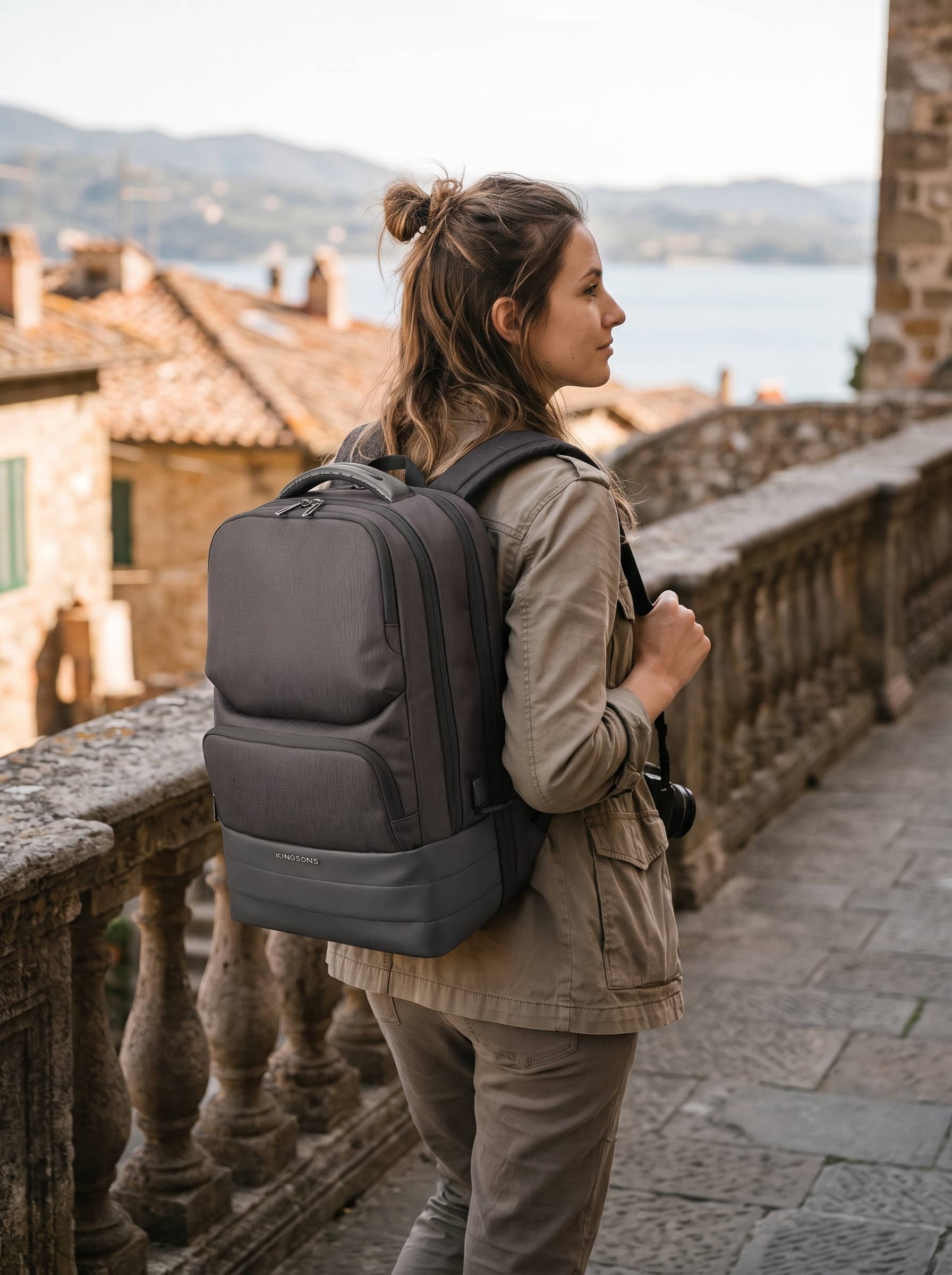 Padded air-cushion straps, a breathable back panel, a soft top handle. At 1.15 kg empty, the bag isn’t a featherweight for its size: a 20-litre hiking pack often weighs less. Most of that weight comes from padding and zips.
On a city walk, the weight stays manageable. After several hours loaded, the straps pull on your shoulders, like any soft bag without a hip belt. The back pad helps air move.
Power banks on a plane: the 100 Wh rule
The USB port is useless without a power bank, and that battery never travels in the hold. The US rule, followed by most airlines, caps each lithium battery at 100 Wh. Between 101 and 160 Wh, you need airline approval, with two spare batteries at most, as the US aviation administration explains.
A quick calculation helps. A 10,000 mAh battery stores about 37 Wh, a 20,000 mAh about 74 Wh: both pass. A 30,000 mAh battery sits near 111 Wh and needs approval. Take the battery out of the bag at security: US screening rules require it in the cabin.
Who this bag suits, and who it doesn’t
At 36.90 €, the bag targets a specific use: city trips, weekend trains, nomad workdays. It suits you if you carry a 13 to 15-inch laptop.
If you’re heading for a hike, look elsewhere: no hip belt, no rigid volume. Nor does it suit anyone who needs certified theft protection, an RFID pocket or a built-in lock. And you don’t want a 40-litre cabin bag for two weeks.
Returns are possible within 30 days, and the legal 14-day withdrawal right applies to online purchases in the European Union, as explained on the consumer rights site.
Verdict: a reasonable buy at 36.90 €
What you pay for: water-repellent polyester, a padded laptop compartment, hidden zips, a USB pass-through and decent straps. What you don’t pay for: a lock, RFID, full waterproofing, fast USB-C.
The internal comparison helps. The commuter backpack in the shop costs 22.90 €: simpler, with no USB port and no hidden zips. The 14 € difference buys exactly the anti-theft system and the pass-through. If both earn their keep every week, the gap is justified. If you take the train twice a year, a simpler bag is enough.
Our view: a good buy for city days and weekends, provided you already own a power bank. This bag doesn’t replace a safe.
Conclusion: buying peace of mind, not a gadget
An anti-theft bag makes nothing untouchable. It removes the easy access, the two-second move in a packed carriage. At 36.90 €, that’s an honest trade: you gain time, you lose the illusion that your bag is open to everyone.
For more, read our guide to avoiding excess baggage fees and our pick of carry-on backpacks for 2026.
Our selection for this trip
From our shop, chosen to match this guide:
 Anti-theft travel backpack with USB portHidden zips, padded laptop compartment, USB pass-through. 47 × 31 × 16 cm, 1.15 kg.€36.90
 Compression packing cubes, set of 6Six compressible bags to sort clothes and toiletries inside the backpack.€19.90
 Rechargeable hand warmer & power bankThe battery that makes the USB port useful: pocket hand warmer and phone charger.€22.90
Plan your trip & start walking
Ready to travel with a bag that closes against your back? Bookmark this guide, pick your silent walk, and check the battery before you leave.