Airplane foot hammock for travel and desk: what 11.90 € actually buys
Airplane foot hammock at 11.90 €: 123 g, 42 cm strap, Oxford fabric. It helps at a desk and on trains. On planes, Delta and Qantas explicitly prohibit it.
Key takeaways
- Price checked on 7 November 2026: 11.90 €, free shipping.
- 123 g, Oxford fabric, adjustable strap of about 42 cm, black, one size.
- Delta lists "foot hammocks and slings" among specifically prohibited items.
- Qantas lists "leg hammocks" among prohibited inflight accessories.
- At a desk or on a train, no specific rule applies.
- It is not a medical device, and it doesn't replace walking.
What 11.90 € buys: the spec sheet, without the packaging
The foot hammock is three parts: an Oxford fabric panel, a strap and a clip. No pump, no frame, no battery. The listing gives 123 g, a strap of about 42 cm, one size and a black colour. The packaging measures 150 × 100 × 40 mm and holds one piece.
At 11.90 € with free shipping, you’re buying a positioning aid, not a reclining seat. The fabric supports your calves or ankles; the strap attaches the sling to whatever anchor is available. The rest depends on the seat, the tray table and the airline.
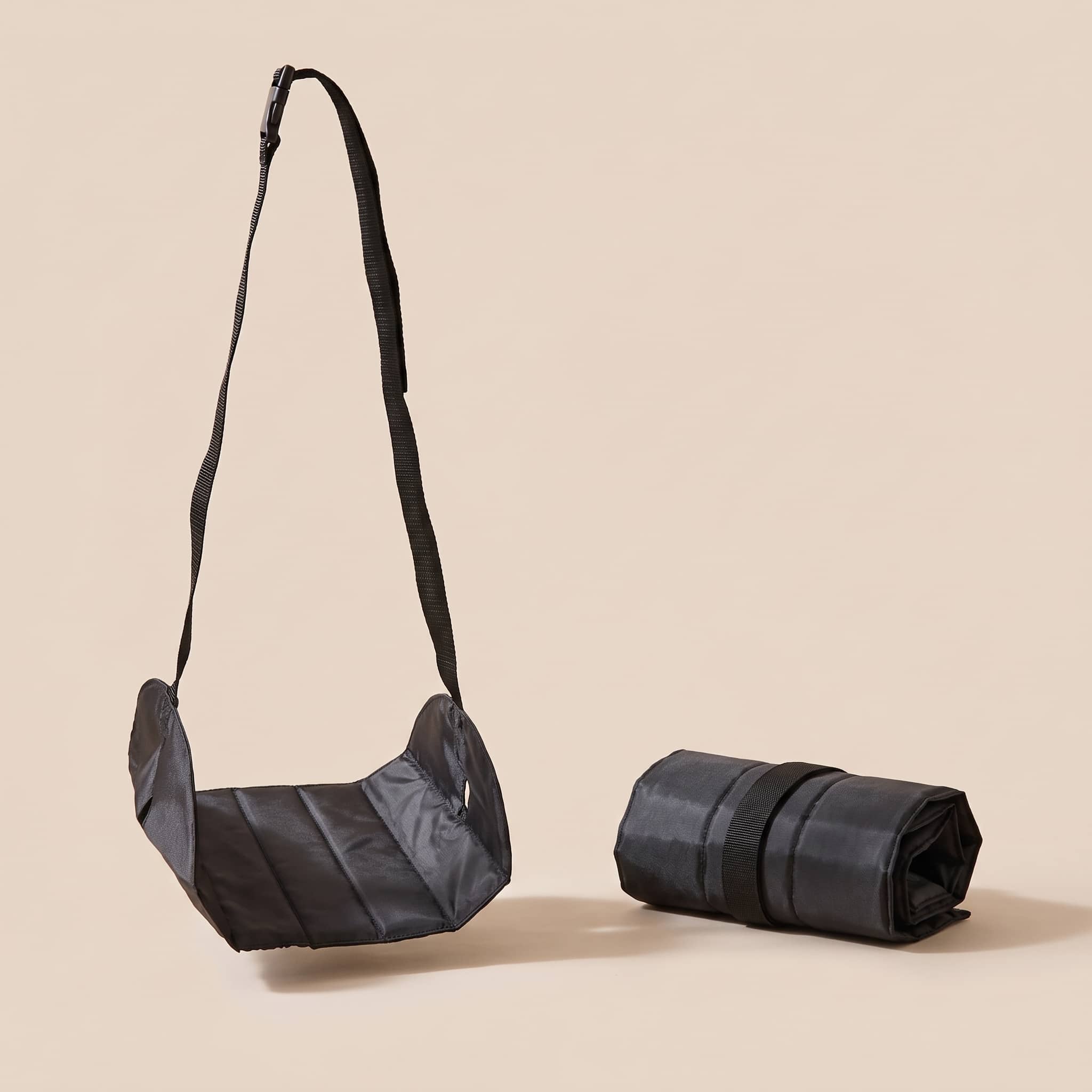 Two details matter more than the price. The clip closes the loop, so the hammock doesn’t slip when the strap loosens. The edges are stitched, with no rigid frame: you fold and unfold the fabric by hand.
The real problem: six hours with dangling feet
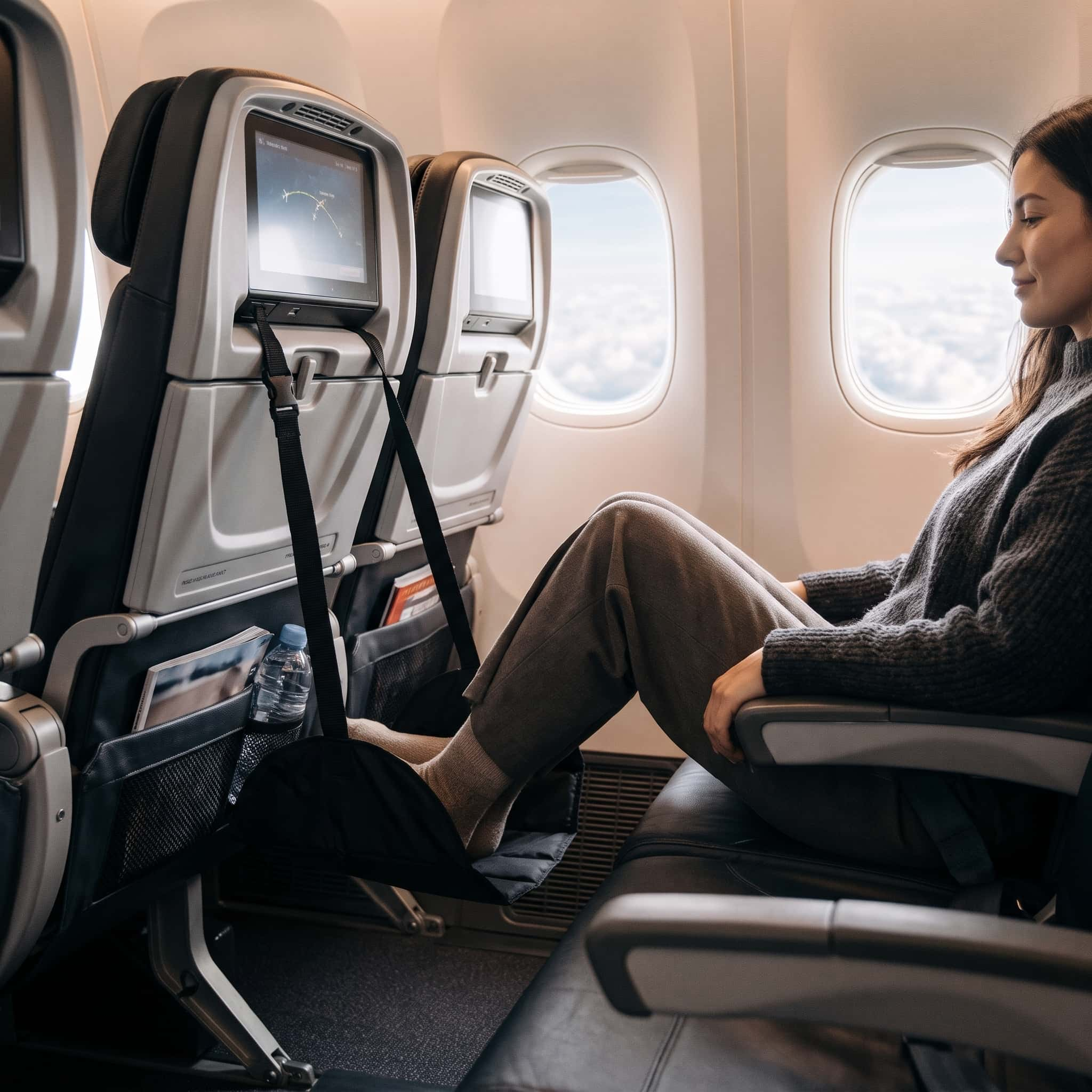
In economy, the gap between the seat and the floor depends on the seat, not on your legs. Shorter passengers rest their feet on their toes; taller ones press their knees against the tray table. Either way, the position stays the same for hours.
The hammock adds support under your calves. You can lift your legs slightly, cross your ankles or switch legs without putting your feet on the cabin floor. On an eight-hour flight, that variation matters more than it sounds.
It doesn’t fix circulation. The CDC says sitting still for more than four hours raises the risk of a blood clot, and recommends getting up every two to three hours. A hammock doesn’t replace a walk down the aisle or ankle exercises.
How to set it up: two gestures and one adjustment
Set-up takes less than a minute, provided you have an anchor point. Three steps are enough:
- Open the clip and pass the strap around the tray-table support, under the seat or around the edge of a desk.
- Close the clip and adjust the length: the hammock should hang at calf height, not stretched like a garden hammock.
- Put your feet in the centre of the fabric, then adjust one notch if your knees rise too high.
On a plane, the anchor is the tray table or its support. That’s exactly the set-up Delta and Qantas object to. At a desk, the strap goes around the edge of the tabletop; on a train, it hooks around the tray-table support, as on a plane.
Two ways to hang it
- Around the tray-table arm: the strap loops around the support and the hammock hangs facing your legs. This is the sturdier set-up.
- Around the edge of the tabletop: the strap grips the edge and the fabric hangs down the side. This is the simpler desk set-up.
Setting the strap
Three checkpoints beat a manual:
- Your thighs stay on the seat.
- Your calves find the fabric without your knees rising.
- Your heels don’t touch the floor, and the strap doesn’t pull on the tray table.
The strap measures about 42 cm. Shorten it and the hammock rises towards your knees. Lengthen it and your feet drop lower.
On a plane: what airlines actually publish
Two airlines publish an explicit rule. Delta lists “foot hammocks and slings” under “Specifically Prohibited” on its carry-on baggage page. Qantas lists “leg hammocks” among prohibited inflight accessories and says the cabin crew decides on other devices.
| Airline | Published rule | What it means |
|---|---|---|
| Delta | ”Foot hammocks and slings” are explicitly prohibited. | Don’t set it up in the cabin. |
| Qantas | ”Leg hammocks” are listed as prohibited inflight accessories. | The crew can refuse set-up. |
| Other airlines | No specific rule published at the time of writing. | Ask the crew before hanging it. |
A missing rule isn’t permission. Without a published text, the crew’s approval is the only reliable answer. Qantas puts it most clearly: the decision rests with the cabin crew.
The night-flight case
On a night flight, the temptation is stronger: legs swell, shoes tighten, lights go down. It’s also when crew move through the aisle most often and safety instructions are repeated. At 11.90 €, the hammock doesn’t buy you the right to install it against the airline’s wishes.
Why the cabin is the wrong place
The hammock turns the tray table into an anchor. But the tray table belongs to the seat in front of you, occupied by someone else. When that passenger reclines, the strap tightens or slackens; your foot follows. The hammock stops being a stable support and becomes a moving part in an already narrow space.
What a tray table can and cannot hold
A cabin tray table is there for a meal tray or a laptop. It isn’t designed to hold a leg. The weight of a calf isn’t huge, but it adds to the tray and the elbows. Three reasons explain the bans:
- The strap changes the normal use of the seat and the tray table.
- It can disturb the passenger in front or block the aisle.
- It slows down the movement of standing up, which matters in an evacuation.
At a desk: the strongest use
This is where the product makes sense. A standard desk leaves your feet without support; shorter users rest a foot on the desk bar, others cross their legs. At 11.90 €, the hammock adds a soft surface under the calves and lets you work with your knees at a right angle.
It doesn’t replace an ergonomic chair. It completes a desk that’s already set up: adjusted seat, screen at eye level, stable feet. If your chair is too high, the hammock can become a bad habit: it hides the problem instead of fixing it.
Set-up for a standard desk
- Hook the strap around the edge of the tabletop, not a drawer that slides.
- Let the hammock hang at mid-calf, without pulling on your knees.
- Stand up at least once an hour: no accessory replaces walking.
If you have to push with your feet to stay balanced, shorten the strap.
On a train: the simplest case
On a high-speed or intercity train, the tray table is often fixed to the seat back in front of you, as on a plane. The difference is space and rules: no specific rail rule turned up for this guide. The hammock is therefore easier to install, provided you don’t disturb your neighbour.
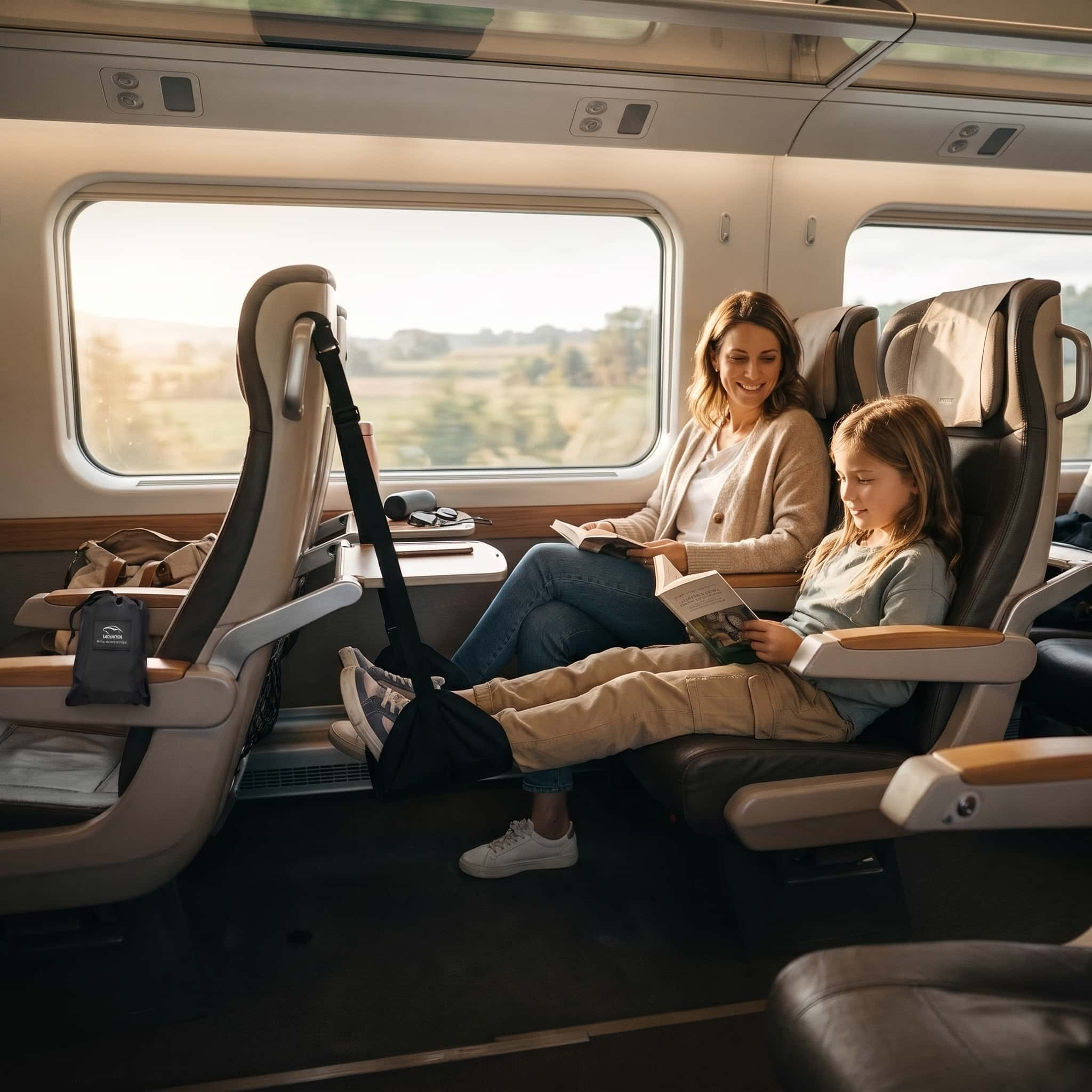 In a sleeper, the hammock loses its point: you’re lying down, with your legs on the berth. On a seated night train, it becomes useful again, especially on journeys over six hours. Our guide to night trains in Europe covers reclining seats and couchettes.
Three precautions are enough:
- Check that the tray table is fixed before hanging the hammock.
- Leave the aisle clear for your neighbour.
- Remove the hammock before arrival, so you don’t leave it under the seat.
123 g in a carry-on: what that changes
The hammock weighs about 123 g, roughly the weight of a light phone. Folded, it takes up a roll of 150 × 100 × 40 mm. The clip lets you hang it on the outside of a carry-on, as in the product photos.
Three reasons to put it in your bag:
- It contains no battery and no blade, so it doesn’t trigger a special check.
- It doesn’t take the space of a pair of shoes.
- It works at a desk and on a train, not only on a plane.
In the cabin, weight isn’t the issue. Space isn’t either. The real obstacle is permission to use it, not transport.
What it really costs
The listed price is 11.90 € with free shipping. Delivery is quoted at 12 to 30 days with a tracking number. Returns are accepted within 30 days, and the legal 14-day withdrawal right applies to online purchases in the European Union, as the official EU consumer portal explains.
The real budget depends on what you already own. A hammock on its own is enough: no battery, no app, no subscription. That’s also its limit: at this price, don’t expect reinforced seams or a competition-grade strap.
What not to expect
The hammock doesn’t straighten your back, support your lower back or replace a neck pillow. It doesn’t prevent thrombosis: the CDC recommends moving every two to three hours, and a hammock doesn’t do that for you.
It doesn’t fit everywhere. Bulkhead seats have no tray table in the seat back; seats without a tray table, or rows where the table is broken, leave the hammock without an anchor. On a reclined seat, the strap can slip. And a hammock that’s too tight pushes your knees up, which is more tiring than relieving.
Safety: three rules to follow
Three rules beat a manual:
- Stow the hammock for taxi, take-off, landing and turbulence.
- Never fix it in a way that blocks the aisle or the seat in front.
- Ask the cabin crew before setting it up on a plane.
These rules aren’t specific to the hammock. They apply to any accessory that changes the space around a seat. When in doubt, the crew’s answer beats the product manual.
The alternatives at 11.90 €
At 11.90 €, the hammock is the cheapest comfort accessory in the range. The shop’s sleep kit, at 24.90 €, targets your neck and eyes: U-shaped pillow, mask and earplugs. The hand warmer at 22.90 € targets the cold, not your legs. None replaces the other.
If your goal is better sleep, the sleep kit is more useful. If your goal is a different leg position at a desk or on a train, the hammock costs half as much. If your goal is blood circulation, no accessory replaces medical advice and walking.
Verdict: buy it if…
The hammock is worth its 11.90 € in two cases. You sit at a desk for several hours a day and your feet want support. You take the train several times a year and want to change position without putting your feet on the floor.
It isn’t worth it if you’re buying it for a long-haul flight. Delta and Qantas prohibit it, other airlines can refuse it, and the crew has the final say. An accessory that’s banned when you need it doesn’t help.
Shipping is free, returns are accepted within 30 days and the 14-day withdrawal right applies. At this price, the trial is low-risk. Read the return policy before you order.
Conclusion: a comfort accessory, not a cabin right
The foot hammock does one thing, and it does it well: it gives your legs support when the seat has none. At a desk, it’s a comfort gesture for 11.90 €. On a train, it’s one more item in your bag. On a plane, it’s a rule question, not a comfort question.
To prepare for a long flight, read our long-haul flight survival guide and our pick of carry-on backpacks for 2026. For the rest, our travel essentials checklist covers the basics.
Our picks for this trip
From our shop, chosen to match this guide:
 Airplane Foot Hammock for Travel & DeskOxford fabric, adjustable strap of about 42 cm, 123 g. Folds and clips to the outside of a carry-on.€11.90
 Memory Foam Travel Pillow, Mask & EarplugsThe sleep kit for planes and trains: U-shaped pillow, 3D mask and earplugs.€24.90
 Rechargeable Hand Warmer & Power BankFor cold flights and winter stopovers, with a phone-charging function.€22.90
Prepare your trip & start walking
Check your airline’s rule before you leave, put the hammock in your carry-on and keep your feet moving. Walking is still the best accessory.